
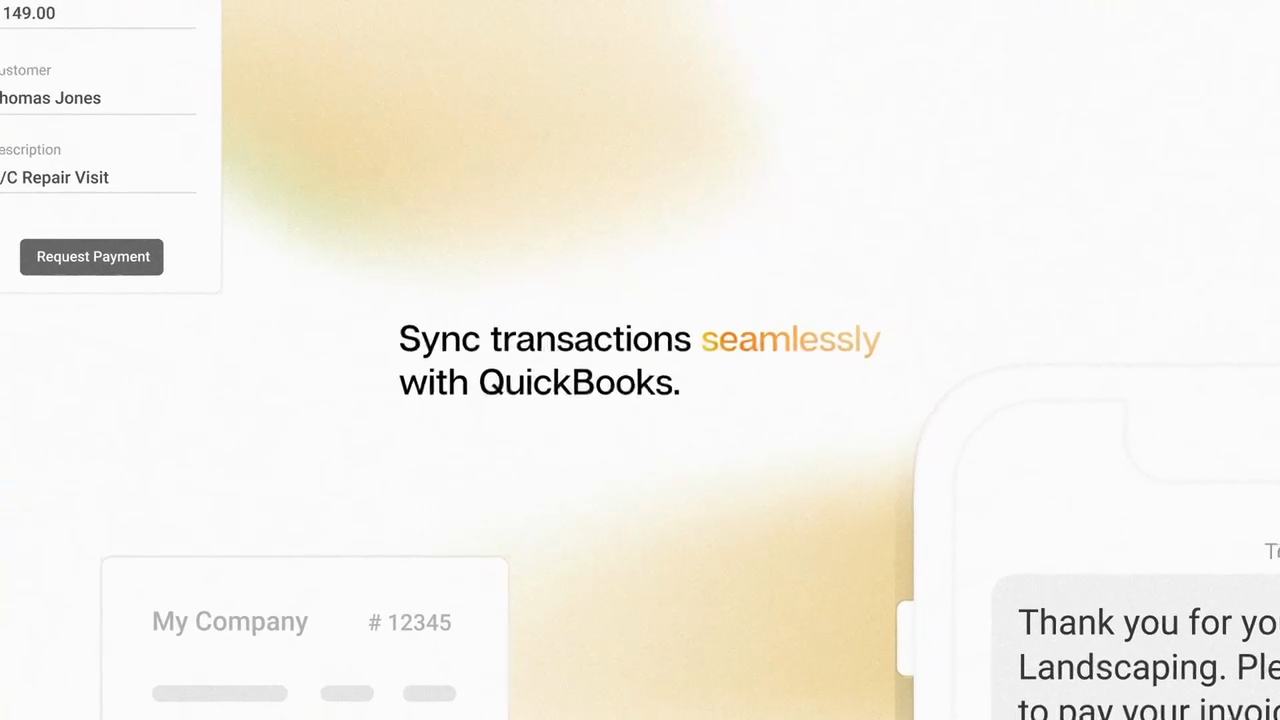
LastPay‘s product looks the way a payment processor should look in 2026. Co-founded by Austin Diaz and Max Umlas, the company built a platform where most of the work happens inside the customer’s existing tools. The processor sits underneath, doing the moving, and stays out of sight until something needs the owner’s attention.
The workflow starts in QuickBooks. An owner closes a job, generates an invoice, and clicks send. LastPay handles dispatch. The customer receives the invoice with a clean payment link. They can pay by card or ACH, depending on what the business has enabled. The transaction routes through LastPay’s processing infrastructure.
The moment the payment clears, the result writes back into QuickBooks. The invoice marks paid. The deposit reconciles to the bank feed. The owner does not have to touch a spreadsheet, export a report, or mark anything by hand. The two systems are talking in real time, and the owner is the beneficiary of that conversation.
Reminders are part of the same loop. If a customer has not paid by day seven, LastPay sends a polite nudge. If the invoice is still open at day fourteen, the next reminder goes out. Owners can customize the cadence and the tone, or leave the default settings on. The follow-up does not depend on a human remembering to send it.
Reporting takes a few clicks. An owner can pull effective rate, settlement timing, and dispute volume in a single dashboard. The data that used to require a portal login and a coffee break is now visible the moment the owner opens the platform.
The savings are the headline, but the workflow is the reason customers stay. Owners who have spent years paying a Friday morning reconciliation tax tend to feel the change immediately. The hour they used to lose every week reappears.
What LastPay’s roadmap signals is that the same workflow is on its way to other accounting platforms. Sage, NetSuite, Xero, and Go High Level are next. The pattern will be the same. Invoice in the customer’s tool. Payment through LastPay. Reconciliation back into the ledger. No exports, no swivel chair, no Friday tax.
Reporting earns a longer look. The dashboard rolls up effective rate, settlement timing, dispute volume, and fees by card brand into a single screen. An owner who used to wait for a monthly statement to ask questions can now answer those questions in real time. The data is the same data the company uses to run its own operations. There is no separate executive view with prettier numbers.
Disputes route through a workflow that does not require the owner to fight every claim alone. LastPay surfaces the dispute, prepares the documentation, and submits the response on the customer’s behalf. Owners can review the case before it goes out or trust the default. Either way, the dispute does not become a lost evening.
Error handling is the part most processors hide. When a transaction fails, LastPay returns the network reason code in plain English alongside a recommended next step. The customer’s bookkeeper does not need to memorize a card brand decline matrix. The platform does that work.
The team built the workflow with one design principle in mind. The owner’s hands should never have to leave QuickBooks for a routine task. Anything that breaks that principle is treated as a bug. New features ship through the integration. Reports surface inside the existing dashboard. Settings are reachable without a separate login. The principle has produced a product that gets out of the way faster than its competitors.
The product is not flashy. It is not trying to be. It is doing the boring job better than the incumbents, and it is doing it inside the tools the customer already pays for. That is the entire pitch. Owners who try the workflow tend to keep it.
For a closer look at the platform, watch Sending Invoices On QuickBooks With LastPay on the LastPay YouTube channel.